
South Charleston Directory Shelves
The historical South Charleston city directory trail rests on two verified Charleston-area collections. Kanawha County Public Library keeps the recurring Polk run, while the West Virginia State Archives lists many older and later Charleston volumes. Neither keeper promises a separate South Charleston-only series. Check each edition's geographic coverage and the way it labels neighboring suburbs.
| Collection | Years or span | Where held | Access |
|---|---|---|---|
| Polk's Charleston City Directories | 1908 to present; Charleston and neighboring suburbs | KCPL Main Library, third floor | In-library only; no checkout or hold |
| Charleston city directories | Listed volumes from 1874-75 through 2016, with gaps | West Virginia State Archives | Archive inventory and on-site or written research |
| West Virginia State Gazetteers | Selected years from 1877 through 1924 | West Virginia State Archives | Limited person and business entries |
| KCPL newspaper resources | Dates vary by title | KCPL Local History and Genealogy | Access Newspaper Archive in the library |
| Charleston/South Charleston Sanborn maps | Listed sheets from 1884 through 1933 | WVU WVRHC | Digitized TIFF images and reference help |
The State Archives list includes 1874-75, 1883-84, 1888-1890, 1893-96, 1899, 1901, 1903-07, and many later dates through 2016. Gaps are real, but the inspected sources do not explain each one. They also do not identify a first or last South Charleston-only edition. Use research-safe labels such as Charleston-area directory and verify suburban inclusion volume by volume.
Polk Covers South Charleston Neighbors
The KCPL Polk collection is the practical recurring shelf for South Charleston genealogy. Its official description covers Charleston and neighboring suburbs from 1908 to the present. The books are on the Main Library third floor. They remain in the library and cannot be checked out or placed on hold.
Begin with an edition near the target date. Search the alphabetical name section, then look for a street or reverse section if that volume includes one. Record the title page, edition year, abbreviation key, and exact entry. The official page confirms the directory run but does not promise a separate reverse series or give its years, so an in-person check is necessary.
The Polk directory collection page identifies the library-only rules and area coverage.
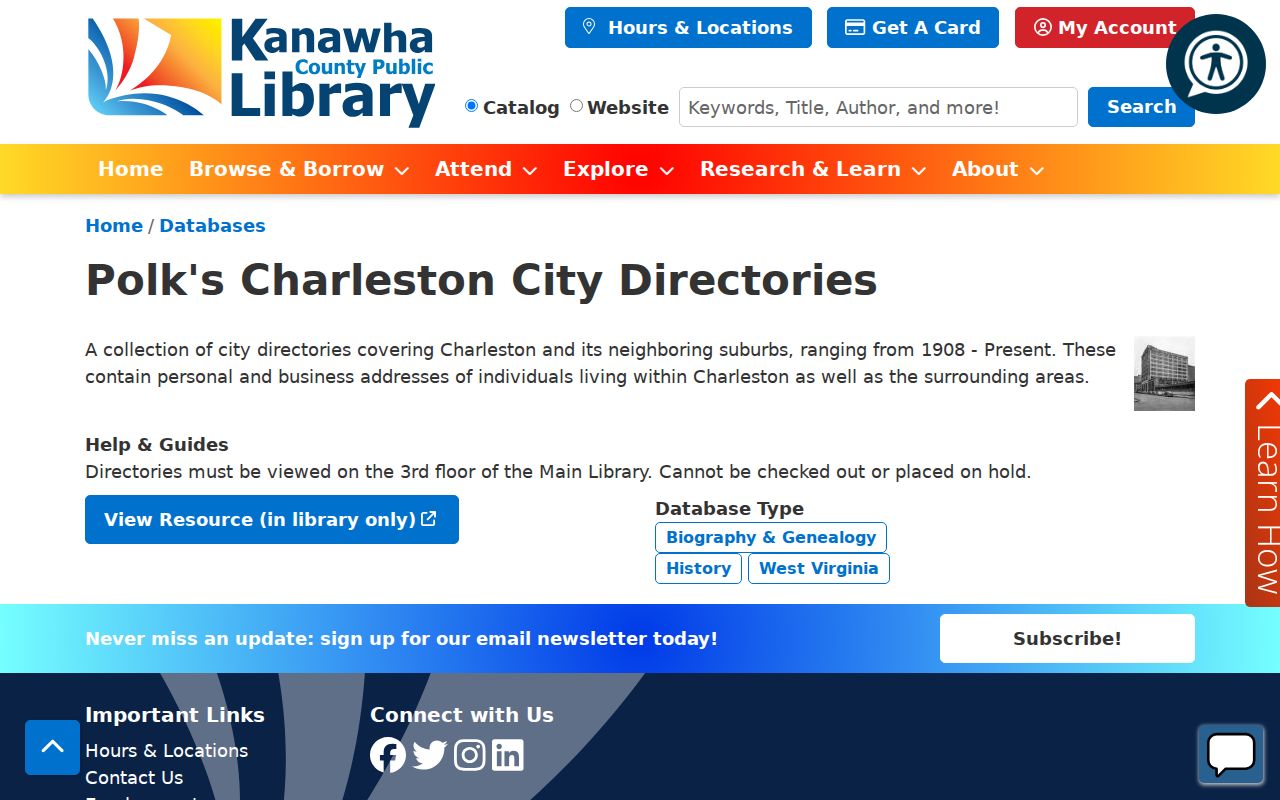
The collection screen confirms where the volumes live, while the physical books supply the names and addresses needed for a South Charleston directory search.
Archives Extend South Charleston Directories
The West Virginia State Archives directory inventory reaches earlier than KCPL's verified Polk span. After its nineteenth-century volumes, it lists 1901, 1903-07, 1909, 1913-15, 1917-18, 1920, 1922, 1932, 1936, 1938, 1940, then selected wartime and postwar editions. A long run covers 1954 through 2000, followed by listed dates in 2004, 2007, 2008, 2010, and 2012-16.
State gazetteers help where a city volume is absent. The archive lists selected gazetteers in 1877, 1882-84, 1891-92, 1895-96, 1898-1919, and 1923-24. Their person and business coverage is limited. A gazetteer hit is a bridge to another record, not a substitute for a household directory.
The State Archives holdings screen displays the year inventory used to plan a visit or request.
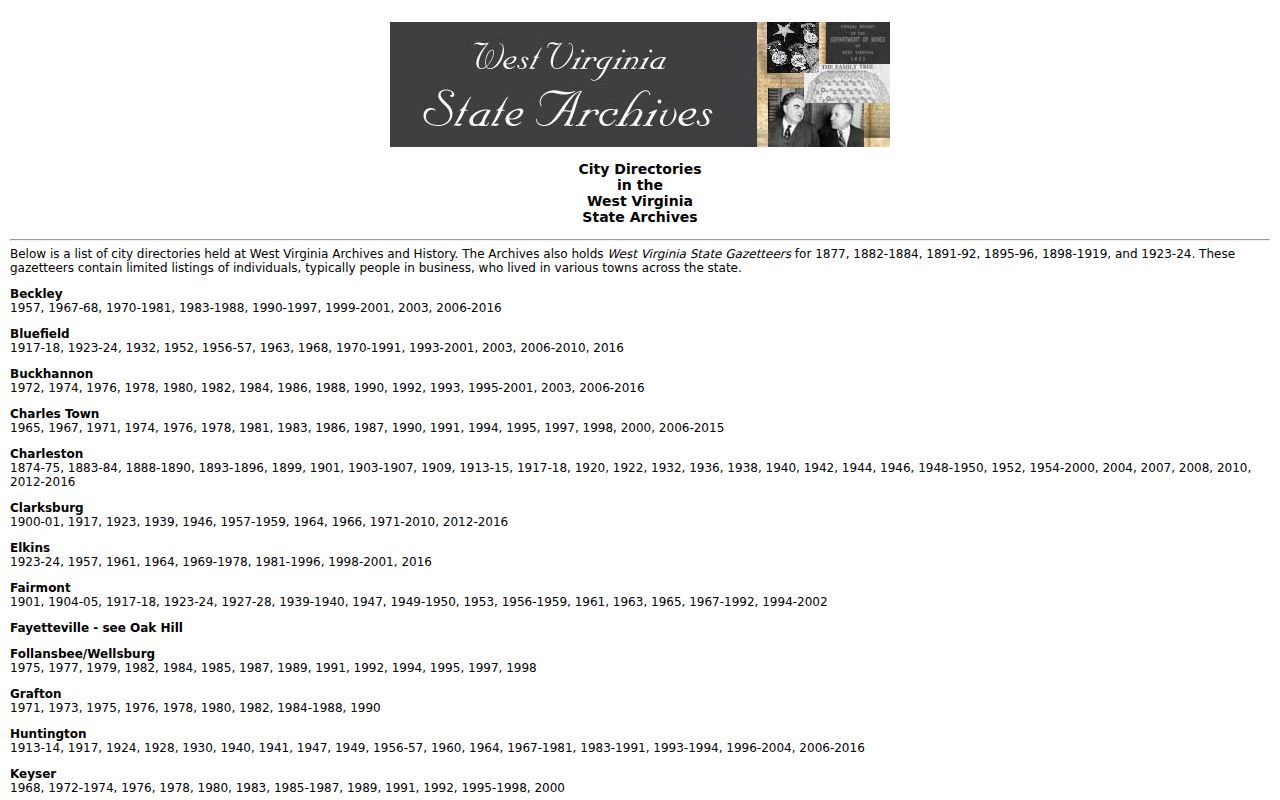
The screenshot is an inventory, not a scan of every volume. Confirm that the chosen edition includes South Charleston before relying on it.
South Charleston Directory Names Shift
An older South Charleston entry may appear under Charleston. The directories are Charleston-titled and their suburban reach depends on the edition. Postal practice adds another wrinkle: USPS changed ZIP 25303's preferred last line from Charleston to South Charleston in 2014. That change does not rewrite older books, deeds, newspapers, or family papers.
Search the same surname and street with both city labels. Compare house numbers, spouse names, work details, and nearby entries. If the street line still fails, use the legal lot, block, or subdivision from the assessor or deed. South Charleston's planned 1906 grid makes those land descriptions useful companions to city directory text.
Note: A changed city label can reflect edition or postal convention, so confirm the parcel and date before treating it as a household move.
Read South Charleston Directory Entries
No actual South Charleston page image was opened during research, so the following is a transcription checklist, not a promise that every edition prints each field. Photograph or copy the abbreviation key first. Then transcribe the whole line exactly, including punctuation and any marks that seem minor.
| Name | Copy the alphabetic name line and all initials. |
|---|---|
| Spouse | Record a spouse shown in parentheses. |
| Work detail | Transcribe an occupation and employer when supplied. |
| Address | Keep the house number, street, and residence notation as printed. |
| Status mark | Note an owner, renter, boarder, or widow mark only if the key defines it. |
| Telephone | Copy it when printed, without assuming that it remains current. |
- Criss-cross section
- A part arranged by street and house number rather than surname.
- Householder index
- An address-based listing of the person treated as head of the household.
- Abbreviation key
- The edition's own list of shortened words and marks, often near the front.
A city directory reports what its publisher gathered for that edition. Children, transient residents, people outside its coverage, and unlisted households may be absent. Keep the title and year with every transcription so a later reader can return to the same source.
Reverse South Charleston Directory Searches
A reverse or criss-cross section starts with a street rather than a surname. It is useful when the address is known but the household name is not. Find the street, move to the house number, then compare the entries immediately above and below. Turn back to the alphabetical section for fuller name details and test the next available edition.
Do not assume that every KCPL volume has this feature. Exact reverse titles and years were not verified. If the book lacks one, search the alphabetical section by a known owner from the assessor or deed. For a current, address-keyed property path, use the South Charleston street directory.
South Charleston Directory Newspapers
KCPL Local History and Genealogy provides in-person research materials, an in-library Access Newspaper Archive route, and an obituary lookup form path. The direct form URL, fee, exact search limit, and turnaround were not exposed in research. Contact Reference staff at Reference@KanawhaLibrary.org or 304-343-4646 instead of assuming a self-service obituary index.
The South Charleston Public Library is a separate city-facing resource with a West Virginia History and Reference Room, local newspapers, public computers, and copying service. Its page does not establish that it holds a duplicate of KCPL's Polk run. Ask each library about its own holdings rather than merging the two collections.
Search a full name with a spouse or parent, church, cemetery, street, and date range. Newspaper notices can explain why a directory name disappears. Then verify an estate, death, or heir clue through probate, vital, cemetery, or archive records. A missing city directory entry alone can also mean a move, an omission, or coverage outside that edition.
The KCPL research page shows the local-history and newspaper access route.
The library screen is the gateway to staff help and in-library tools that can close a gap between directory years.
Map South Charleston Directory Addresses
The WVU Sanborn maps of Charleston include sheets tied to 1884, 1888, 1893, 1897, 1902, 1907, 1912, 1918, 1919, 1922, and a 1933 set explicitly described as Charleston including South Charleston. The digital object contains 281 TIFF files. These maps show building footprints, construction materials, uses, streets, and nearby setting. They do not name every occupant.
Start with the directory address and choose a map near the same date. Confirm the street and sheet, then compare the building form. For remote help, contact WVRHC at wvrhcref@westvirginia.libanswers.com or 304-293-3536. In-person research is by appointment at 1549 University Avenue in Morgantown.
The WVRHC Sanborn object is the digitized source for structural context.
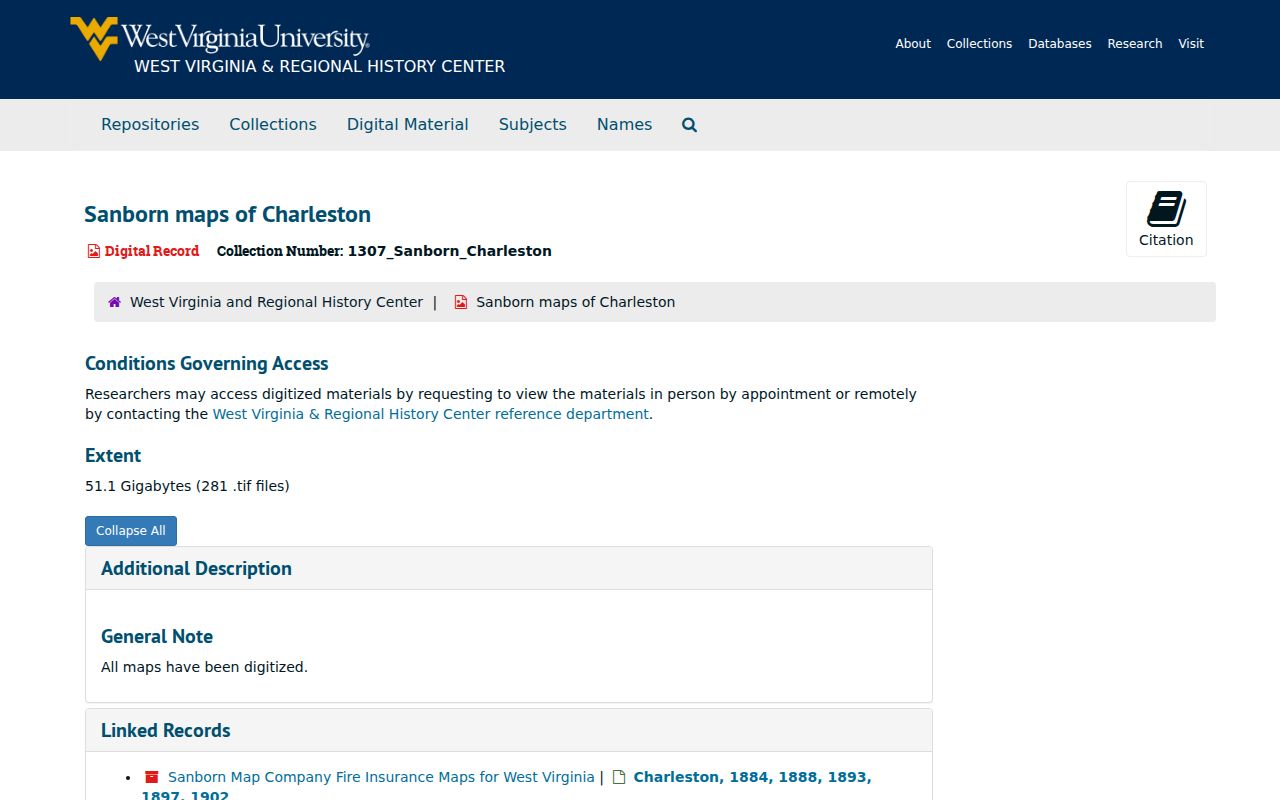
The collection can establish whether a mapped structure existed near a directory date, while the directory supplies the person clue.
South Charleston Directory Families
Local history supplies better search terms than a surname alone. Banner Glass moved from Indiana in 1907 and brought about 40 mostly Belgian and French families into the developing community. Later records may connect households to the naval ordnance plant, Union Carbide, Prestone, the industrial park, Spring Hill, or Jefferson Park. Use those names in newspapers and directory work when a personal entry is unclear.
The timeline also explains why South Charleston records sit inside broader Charleston collections. The planned grid followed a large 1906 land purchase, Banner Glass arrived in 1907, and wartime industrial development accelerated the city's growth. Sources differ between 1917 incorporation and 1919 special-charter language, so attribute the date rather than flattening it into one unsupported milestone.
Trace South Charleston Directory Families
City directories add yearly or near-yearly points between public federal censuses. The public census years useful here include 1910, 1920, 1930, 1940, and 1950. The 72-year federal rule makes 1950 the latest public census in 2026, with 1960 expected in 2032. A census adds household composition, age, birthplace, and geographic context that a directory may omit.
- Find the person's first clear city directory entry and copy the whole line.
- Move through the next available editions, noting address, spouse, and work changes.
- Use a street section, when present, to test the address and nearby households.
- Pair 1948-50 directories with the 1950 census, 1938 or 1940 with the 1940 census, and 1920 or 1922 with the 1920 census.
- Close a disappearance with newspapers, the KCPL obituary route, probate, vital records, or cemetery evidence.
Differences are not automatically errors. A directory canvass and census enumeration occurred on different dates. One source may use Charleston while another uses South Charleston. Children may appear in a census but not the city directory. Keep each event date and publication date separate, then decide which explanation best fits the full trail.
For written archive help, the West Virginia State Archives research service accepts written requests, not research requests by phone or email. Its listed half-hour fee is $10 for in-state patrons and $20 for out-of-state patrons, with up to $2.50 in copies and postage. Copy requests are limited to two specific items and carry separate listed prices.